Who has Full Order Book Data, not market Depth but Full Order Book Data?
databento
1 Like
Data Bento is not good enough, its missing things,
From the CME directly: Pages
CME yeah, $30k or more it’s a bit costly
What things are missing? I thought they are just reselling exchange data.
Btw, I remember presentation from VolSys DOM about iceberg detection which requires MBO to function. They use dxFeed.
Data Bento… monthly cost Standard $199, Plus $1750+, Unlimited $4500… things are missing… then $30K+ is a bit too costly for whatever is missing? 
It starts with monthly plans at $199, then jumps to $1,750, then $4,500 for “unlimited” access, and even then you’re often still missing pieces of the data. What makes even less sense is that after paying thousands of dollars, the truly complete institutional-grade data can still cost tens of thousands more.
The reality is that once traders begin to understand markets, they quickly realize that quality data matters. Yet access to that data has become so expensive that it feels as though retail traders are being priced out before they even have a fair chance to compete.
And if you do manage to obtain professional-grade data, licensing restrictions often prevent you from freely sharing charts, research, visualizations, or products built from it unless additional agreements and fees are paid. The data itself becomes gated, and the ability to educate others with it becomes gated as well.
Then the industry turns around and repeats the statistic that “90% of traders fail.”
Imagine sending a soldier into battle with limited ammunition, outdated maps, and restricted intelligence, while the opposing side has access to everything. When the soldier loses, nobody questions the conditions under which he was sent to fight. Instead, they simply point to the result and say he failed.
That is what many retail traders experience. They are expected to compete in a data-driven environment while operating with delayed, incomplete, or prohibitively expensive information. Then the outcome is treated as a reflection of their ability rather than a reflection of the unequal access to the tools required to succeed.
Perhaps the real question is not why so many traders fail. Perhaps the question is why access to the information necessary to compete remains locked behind barriers that most participants can never realistically overcome. lol 
So… what exactly is it that you are looking for that Data Bento doesn’t provide? There are many people and services that uses Data Bento, but I guess it’s not good enough for you? Most likely, the 99.999999999% of people don’t need whatever is so special that you need, which is probably why it doesn’t exist?
You don’t have to imagine. Vietnam and the Afghan wars are examples where the opposing force had overwhelming firepower and better technology and still loss politically, strategically or morally.
There are many successful traders just using various retail platforms with the data source those platform provides. If you want to compete in the same environment as institutions then you will pay the institution prices. Perhaps as an institutional trader, you may complain about the biggest advantage a retail trader has… size. 
We have become a Trading society that is far more comfortable creating excuses than creating solutions. unless I am wrong
When a problem is identified, the response is often, “That’s just the way it is.” When costs become unreasonable, we are told to accept them. When access becomes restricted, we are told to work around it. When barriers are placed in front of us, we are expected to adapt rather than question why those barriers exist in the first place.stead of asking why critical information is inaccessible to most participants, the industry tells traders to simply accept the limitations. They are expected to compete with incomplete information and then accept responsibility when they fail.
This is the equivalent of being handed leftovers and being told to be grateful for the meal. then again who am I Perhaps the greatest obstacle is not the lack of information, technology, or opportunity. Perhaps the greatest obstacle is that too many people have become comfortable accepting less than what is possible. 
So… what exactly is it that you need that Data Bento doesn’t have? You keep spewing non-sense but never answered what you exactly needed.
It’s a big club and we ain’t in it…also futures is a zero sum game so losers are expected.
https://www.youtube.com/watch?v=upD6cB9Rzvk lol
1 Like
yes, I agree you do have a point lol ,
I don’t think I ever mentioned that I needed more data.
The original question was: “Who has full order book data, not just market depth, but the complete order book?”
That’s a question driven by curiosity, not necessity.
I’m perfectly fine with the data I have today. What interests me is understanding how far developers, quants, institutions, and technology firms have gone in their pursuit of market data and market transparency.
There’s a big difference between asking for data because you need it and asking because you want to understand the limits of what’s available.
Calling that “spewing nonsense” misses the point entirely. Exploring what’s possible is how innovation happens. Every advancement in trading technology started because someone asked questions beyond what they currently needed.
It’s not nonsense. It’s a reality check. The market is constantly evolving, and understanding how far data collection, processing, and analysis have progressed is a legitimate discussion for anyone interested in the development of trading technology. I did reply towards the price value of what u pointed out, I do respect everyone’s opinion, and thank you for being part of this conversation
I didn’t ask if you needed more data. I asked what exactly is it you are looking for that Data Bento doesn’t provide.
You mentioned it’s “missing things”.
Then complain that CME is a bit costly.
Avoided answering what things are missing from Bill and me a few times, but go on spewing non-sense. It is non-sense. You complain about Data Bento missing data, but don’t answer and go on a tangent about data and institutions while not answering what data is missing.
Last time I checked, Data Bento was primarily a distributor and reseller of exchange-provided data. That’s why I’m trying to understand what specific thing you believe I’m missing that’s not data. If they sell candy, I’d expect a bag of candy.
Yes, I did. In fact, it would be helpful if you did your own homework and investigated what may be missing instead of relying on a “he said, she said” discussion. Looking into the actual data, products, and limitations yourself would provide far more precise information than assumptions or second-hand opinions. Once you’ve done that, we can have a more productive discussion based on facts rather than speculation.
lol of course who wouldn’t complain about this lmao, point out one beginner retail trader that wouldn’t complain about this, this is so unfair for the little ones. imagine a new trader comes in, and they get hit with well u need 30 k to be on the same level of data transparency so u can have a chance in the markets, but yet u think this is ok, seems like that data bento hit u hard do you work for them or something, this isn’t personal, it’s just an open topic of conversation, I do thank you for your expression, then again I also make sure I stay neutral at all times so I can see both sides of the story,
We literally have no clue what YOU think is “missing” which is why we asked you. You were the one that said it’s “missing things” so we asked what is missing.
You literally said Data Bento is not good enough and “missing things” and imply through other comments that you need the same data as institutions to be successful, but then complain about institutional pricing which you listed $30K.
After all of this… you still can’t tell us what is missing from Data Bento that you need.
In all seriousness, jokes aside,
How deep into trading data do you think someone needs to go to become a successful trader? And how deep into trading data does someone need to go to become a successful trading-system developer?
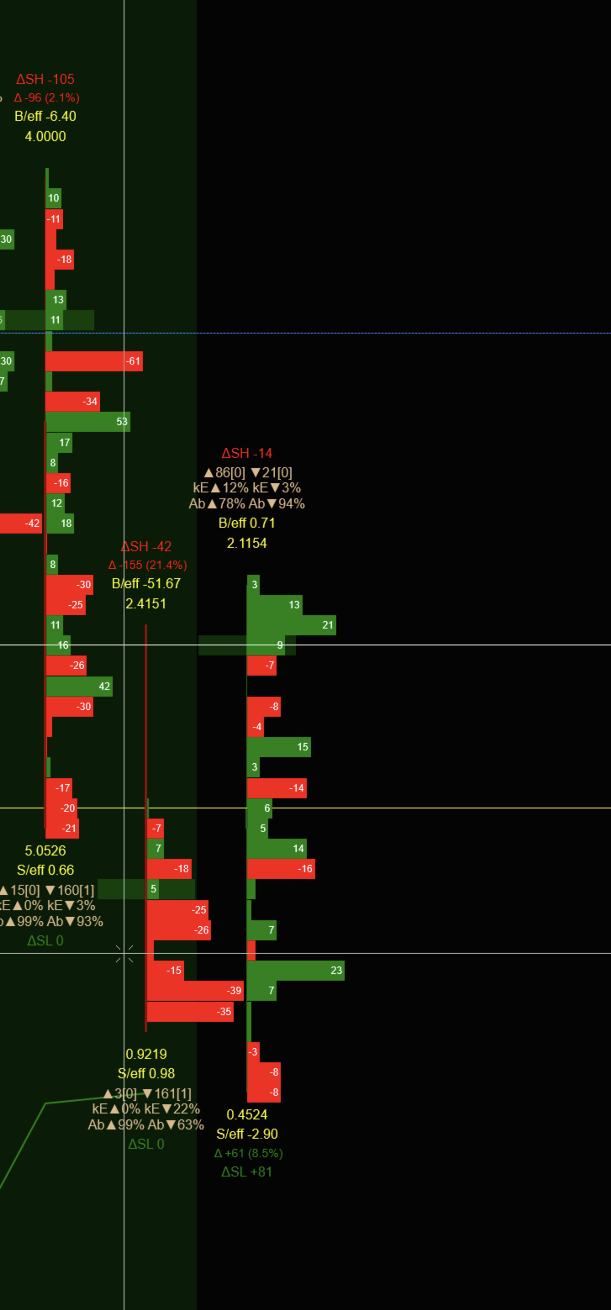
As a scalper, and if you’re looking to participate and perhaps feed yourself and your family, really it’s about learning all the terminology not simply from a knowledge standpoint, but from a practitioner standpoint. The screenshot I have here is simply a particular delta chart it shows me how delta is moving, and then combine with logic and a little bit of psychology in terms of pain points, and where people are willingto give up, you can position yourself and make an amount that would be sufficient daily for a living. It is grueling. This form is grueling. And it is boring as hell.
1 Like
That is actually a very good method. My only point is that it is still based on historical events ,what has already happened. In other words, we’re making decisions based on the evidence left behind.
Let me give an example.
Imagine two people observing traffic in a parking structure. One person is standing outside the exit. All he can see is the direction each vehicle takes as it leaves the building. The other person is already inside the parking structure, watching the line of vehicles waiting to exit and seeing their turn signals long before they reach the exit.
Who has the greater advantage?
The person inside has access to information earlier. He can see intent before the action becomes visible to everyone else.
I’m not disagreeing with your method. In fact, it clearly works for many traders. My point is that additional data can sometimes provide context and improve decision making. Whether that’s Level 2, market depth, order flow, liquidity, or some other form of market data, it can offer a glimpse of what’s developing before it becomes obvious on the chart.
At the same time, I fully respect every trading style. Some traders rely on chart patterns, support and resistance, highs and lows, trend structure, or pure price action and are extremely successful. Others prefer to incorporate deeper market data into their process.
At the end of the day, the goal is the same: consistently identify an edge and manage risk effectively. The tools may differ, but the objective remains unchanged.
However, there is one major difference in all of this: time and cost.
Every trader eventually pays tuition to the market. The question is how much time and money it takes before the lessons are learned.
A trader relying solely on price action and historical information can absolutely become successful, but often that understanding is developed through years of screen time, trial and error, and sometimes significant losses along the way.
Additional data is not a guarantee of success, but it can accelerate the learning process. It can provide context that may otherwise take years of experience to recognize. In some cases, seeing liquidity, order flow, market depth, or participant behavior can help a trader understand not only what happened, but why it happened.
My point is simply that if two traders ultimately arrive at the same conclusion, but one can get there faster, with fewer mistakes and less capital lost during the learning process, then there is value in the additional information.
At the end of the day, every trader must decide whether they prefer to learn primarily from the footprints left behind or from observing the activity as it develops. Neither approach is inherently right or wrong, but the path, time commitment, and cost of education can be very different.