We’re working on an automation-first trading platform built on NinjaTrader, and wanted to start a discussion rather than make any claims.
One thing we’ve noticed after spending a lot of time inside NT is that most traders don’t struggle with “ideas” — they struggle with “execution consistency” once markets get fast, noisy, or emotional.
We have been focused on:
Embedding risk constraints directly into execution
Reducing discretionary overrides during live sessions
Treating automation as decision enforcement, not signal generation
Designing systems that behave the same way on bad days as on good ones
This isn’t about “set and forget” trading, and it’s not about chasing performance. The question we keep coming back to is whether removing repeated decisions (sizing, entries, exits, session rules) actually improves long-term consistency when using NinjaTrader in live environments.
Curious to hear perspectives from others here:
For those using NT automation, where does discretion still sneak in the most?
What parts of your workflow should be automated but aren’t?
Has automation helped you more with execution discipline or with stress reduction?
What are the biggest failure points you’ve seen with automated systems in NT?
Genuinely interested in how others are approaching automation inside NinjaTrader and where it’s helped or hurt.
I’ve built and used a lot of strategies throughout the years. I think running strategies in a semi-automated way is a better approach for most people. Many traders already know what they want to trade, but emotions and fast markets make consistent execution hard. Using automation to handle sizing, risk limits, and exits removes a lot of those mistakes while still letting the trader decide when to engage the strategy.
For those using NT automation, where does discretion still sneak in the most?
*It doesnt, I made sure during coding and development all discretion was removed, I have a tendency to drift from the plan and get fomo, not good.
What parts of your workflow should be automated but aren’t? For my strategy, I have been able to automate everything, future modifications could require dynamic TP/SL levels if I want to “open up” and take more risk (not likely).*
Has automation helped you more with execution discipline or with stress reduction? 1000% no doubt - this was my whole goal when I decided to automate.
What are the biggest failure points you’ve seen with automated systems in NT? I honestly haven’t encountered any that I can say was an NT issue, at first I think they are but after investigation they ended up being user / coding errors. I did have one issue that was a restriction that prevented exiting managed orders as unmanaged (or something like that, it was awhile ago so I dont remember 100%).*
Both accounts and data feed are in a simulated environment with these funded firms unless they put you into a live account, which is why many will make you pay the data feed. I think it’s $119 a month or something like that.
Hmmm, doesn’t seem like Apex and other Rithmic-based prop firms accounts do that – I mean, the data is coming from Rithmic, which comes from the exchange, right?
For most prop firms I’ve seen, traders in eval accounts don’t pay $119 extra for real-time data, the monthly subscription price is all inclusive. Is that not pretty standard?
Why would a prop firm provide simulated data over real data? Sorry, simulated data makes no sense to me. As a general statement, that seems wrong. What am I missing?
Simulated data makes perfect sense. It’s in a simulated environment. The data feed itself may look the same, but your data feed from these evaluations and simulated funded accounts never hits the real exchange. They don’t pay the $119 a month because its an evaluation and simulated account. Once they go live, most of these funded programs will make you pay for the real data feed. It’s higher because they consider you “professional”.
In the funded firm model, traders who fail and reset their evaluations represent a consistent source of revenue for the firm, as they pay additional fees to restart the process. Traders who successfully pass the evaluation phase and move on to a simulated funded account, however, become a potential liability. Since these accounts are still simulated, any payouts to profitable traders are paid directly out of the firm’s own funds rather than from live market profits. Once a trader demonstrates consistency and is transitioned to a live account, the it changes. At that stage, the firm can generate revenue from actual market performance, by taking a percentage split of the profits earned in live trading. This shifts the trader from being a potential cost center to a revenue-generating partner for the firm.
I understand what you’re saying, but I’m not talking about traders and their relationship to the prop firm. I’m trying to focus on the data the prop firm provides the trader. I understand all eval accounts are actually simulated accounts. And I know that traders who pass their evals usually start with funded accounts working in simulation mode until some degree of profit is reached.
I submit that in all cases where an eval/funded account is in simulation mode, the real-time data is actually real-time, and not simulated.
I don’t understand what you mean by ‘simulated’ data.
As someone who has worked / is working with a few prop firms, the $119 price for data is only for those who are deemed “professional traders”. For those of us in the retail space, level 1 data is included in with your account. That data is indeed real-time and exactly the same as any other account, regardless of whether you are sim-eval, sim-funded, or live-funded. That said, if you do make it to live-funded you more than likely will have to pay the full professional price.
Yes. Maybe “simulated data” isn’t the right term. The data is real time, but you are in a “simulated environment”. It’s not real and separate from live data. It never hits the exchange. It makes zero sense to have the same data feeding both a live and simulated environment. Why do you think these simulated environments seems to go down more often? It’s a different environment. The priority is the real data where “real” money is actually traded on. I’ve seen it many times where these funds would go down, but everything is fine in the “real” environment.
I’ve had live accounts before with some of these firms when I tried them a while ago. You get different connections and have to pay for the “professional” data feed. Your trades hit the exchange.
I think it makes perfect sense for prop firms to provide actual real-time data from the exchange – I mean, why go through the trouble and expense of doing the extra work of providing the ‘simulated data’ you’re talking about? They have the real thing available to their funded live account traders anyways, so why not provide everyone with the same real time data directly from the exchange? Less hassle, less fuss.
What about traders who happen to be trading both eval accounts and live funded accounts from the same prop firm, at the same time? How does that work?
Btw, I don’t quite know what you mean by ‘simulated environment’ – the only thing that is being simulated is the internals of the prop firm account – the NT8 environment treats it like a real brokerage account (not a Sim101 account), the data is real-time, coming from an exchange-based source (like Rithmic), and that same data can be used to trade both prop firm eval accounts and live funded prop/brokerage accounts, at the same time, using a trader copier. To say an eval account trader is in a ‘simulated environment’ is really quite vague and a huge exaggeration of the facts. The only thing in the trading environment being simulated is the internal account, back at the prop firm.
Also, you imply the data is real-time, but yet not real. And how does data ‘hit the exchange’, anyways? It’s a one-way data feed connection, only the order feed connection is two-way.
If you can provide sources, I’d sure like to see the evidence of prop firms providing this ‘simulated data’.
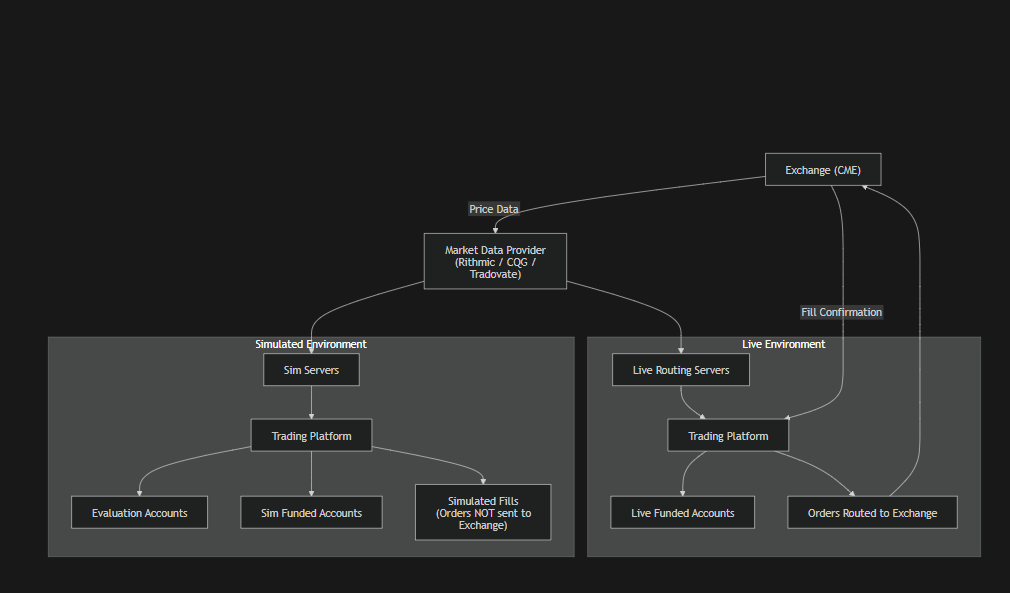
I created a chart for you since it seems difficult for you to understand that a simulated environment is not the same as a live environment. I have never worked in that environment, but I would imagine the pipeline looking something like this general. This is assuming the same data feed that gets split into a live environment and simulated environment.
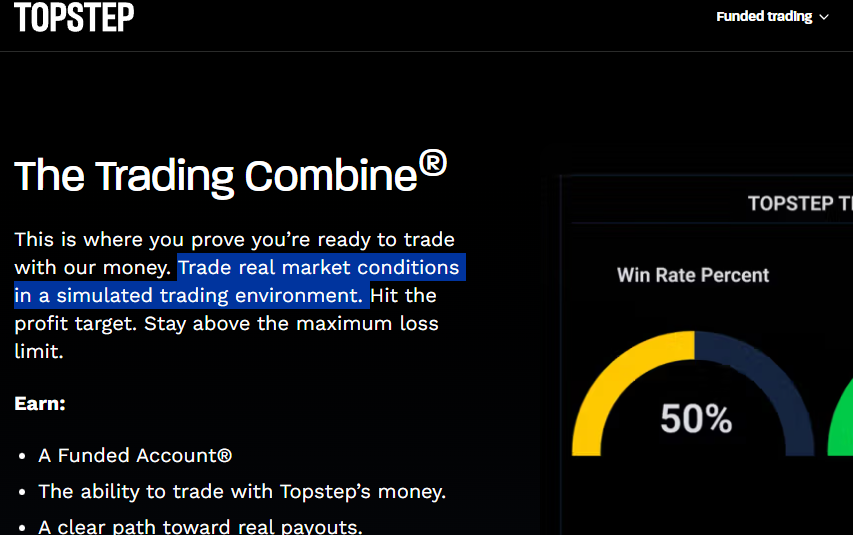
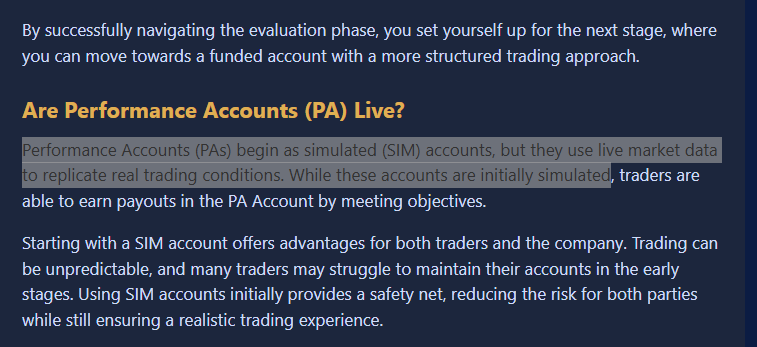
It’s not an exaggeration of facts. It is a fact. If you really want to continue to believe that eval and sim funded are not in a simulated environment then have at it. Here are two examples stating it’s a simulated environment.
The algorithym from citadel and DRW, don’t interact in the simulated enviroment. The simulated environment is just a price movement mirror of what is happening in the real market.
In the real market, you enter a trade and your trade is logged in CBOE futures exchange and other entities can see it, interact with it, etc. The actual market does not see all the trades from the simulation enviroment becuase its a simulation.
In a simulated evironment, you’re in a playground, playing around, (your dataline/datafeed is a simulated line and taps into a sandbox where you’re interacting with other simulation players) whatever that might be TopStep, APEX, etc.
Price discovery in the real market is an interaction between buyers and sellers with real money!
The simulated playground offers a mirror of the price movement derived from the real market.
Think about it like this. Real money is involved in price discovery, not simulation money.
Sorry, I still feel like you’re over-reaching to explain what ‘simulated environment’ means. I’ve never seen your explanation documented anything like what you say.
I think ‘simulated environment’ is simply meant as marketing-speak for ‘simulated account’, with its subsequent simulated orders and imitation profits and losses. The simulated account is supposed to be as close to the real thing as possible, using real-time data and real-time volume. Why? Because it’s a training ground for future funded traders. Why such an emphasis on everything above the simulated account also being simulated still makes no sense to me. The only thing that needs to be simulated is the internals of prop-firm account itself. (Naturally, orders in a simulated account never hit the exchange, that has always been clear, since that is what simulated account means. This has never been the issue.)
Frankly, I see simulated environment as just a marketing euphemism for simulated account. For prop firm simulated accounts, I still think the data feed is real-time data coming from the exchange, but obviously the simulated account order feed stays inside the prop firm’s servers and never hit the exchange.
-=o=-
A NinjaTrader Connection can have one or two feeds associated with it – these are the data feed and the order feed. Some Connections may be data feed only, such as connections to IQFeed or Kinetic. Brokerage and prop firm Connections typically have both an order feed and a data feed component.
Let’s use Apex/Rithmic as an example. If I have 20 Apex/Rithmic eval accounts, NT8 does not create 20 Rithmic data feed connections, it knows to only create one. Same if I have a mix of 10 eval accounts and 10 PA accounts, it knows it only needs 1 Rithmic connection. Ergo, the real-time Rithmic data feed from an eval account is the same real-time data feed from a PA account. The data feed and the order feed are part of the Connection, not part of the account.
All accounts from the same prop firm get aggregated under one single Connection, right? I’m pretty sure that’s the case for all prop firms, am I wrong?
[That is, in the case of Apex, for ex, someone with 10 eval accounts and 10 PA accounts will have all 20 accounts appear in the Account dropdown box when the single connection to Apex is made. You only connect to the prop firm once, using one NinjaTrader Connection with your prop firm credentials, and all accounts, eval or funded, instantly become available. I assume this is how all the prop firms operate, but I only have personal experience with Rithmic based prop firms on NinjaTrader desktop.]
You’ve actually inspired me to investigate your idea of ‘simulated environment’ further with Apex and TopStep. I’ll report back my findings to this thread.
Simulated environment is now market speak? It’s very obvious you have never had a live account with these firms. You get a different connection when you get moved to live… so no longer in simulated environment. Once they move you to a live account, those accounts don’t become “instantly available”. They can take around 3-5 days to create those accounts at the broker.
Because you are paying them to have these accounts created for you at the data provider level (Rithmic/Tradovate) for your user instead of on the trading platform in a simulated environment. These accounts do not exist in the live environment. A single account does not equal to a single connection. They are all under one connection. You are paper trading with evaluations and sim funded/PA accounts. The difference is that they pay you out in sim funded from their own pockets. Sim funded traders who continue to pull out payouts becomes a financial liability, which is why they want to move you to live. It’s hard for me to believe that you are having such a difficult time distinguishing between two separate environments.
Plato’s Allegory of the Cave, from Book VII of The Republic, describes prisoners chained in a cave who mistake shadows on a wall for reality, representing the world of appearances
If participants have never had experience with the real market, I don’t think it they can gain understanding.
You’re not addressing my core assertions, which are, 1) the data feed provided by a prop firm simulated account is a real-time data feed from the exchange, and 2) the data feed for a prop firm simulated account is no different than the data feed for a prop firm live PA/funded account.
I will report back after I investigate more in depth with a few PA firms.

 and other entities can see it, interact with it, etc. The actual market does not see all the trades from the simulation enviroment becuase its a simulation.
 It’s very obvious you have never had a live account with these firms. You get a different connection when you get moved to live… so no longer in simulated environment. Once they move you to a live account, those accounts don’t become “instantly available”. They can take around 3-5 days to create those accounts at the broker.