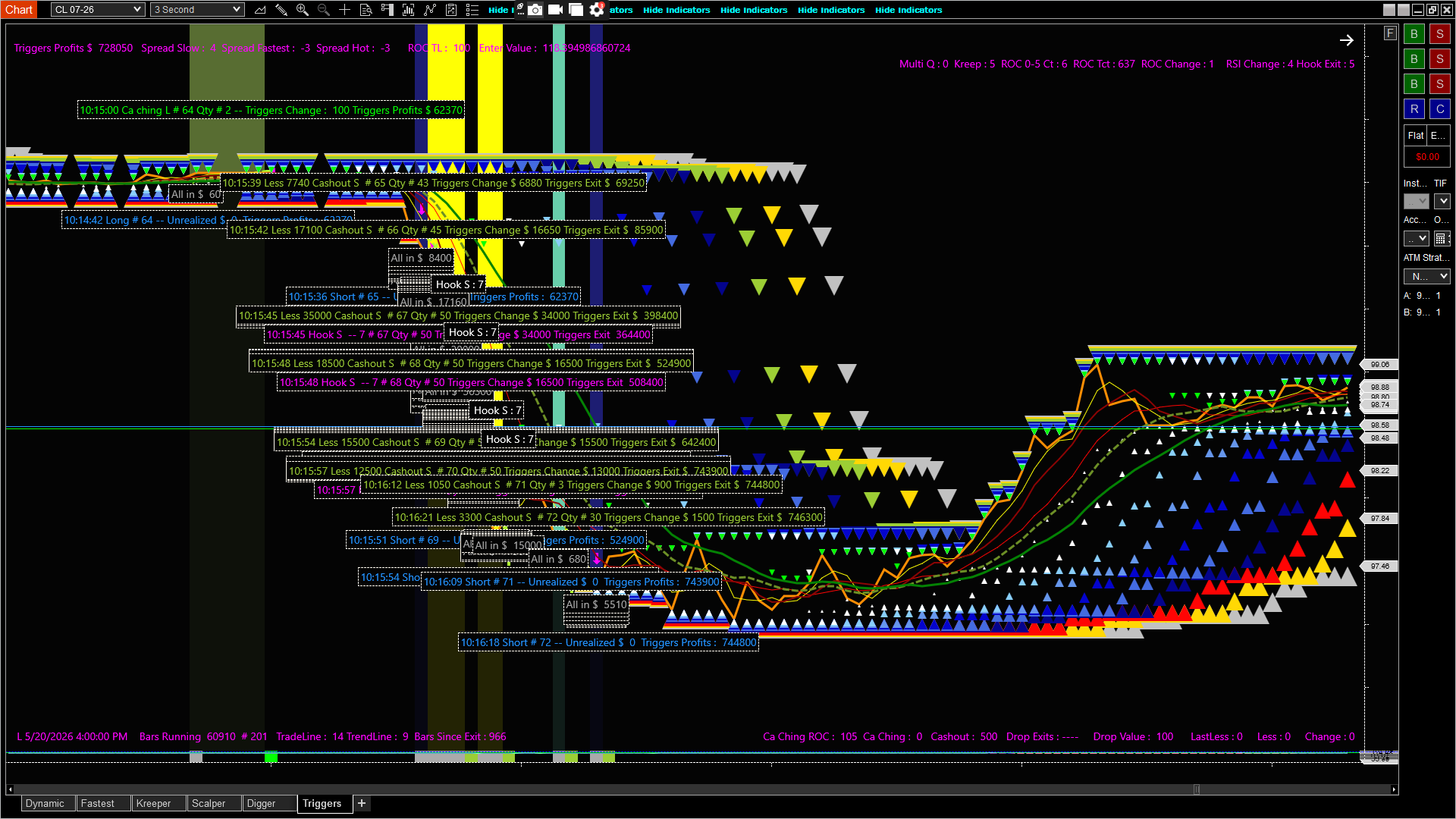
A lot of guys blowing funded evaluations during the first 30 seconds of the NY open aren’t actually wrong on market direction, the issue is that the NT8 chart renderer aggregates tick data differently than the raw Rithmic or Tradovate feed hitting the exchange
If you fire a standard market order during a fast liquidity sweep, your chart is actually showing you a ghost price from 200 milliseconds ago. That resulting slippage instantly eats your trailing drawdown limit. Stop relying on visual chart data for high-volatility entries, if you want to survive the open, you have to hook your entry scripts directly into the raw Level 2 data stream and use unmanaged limit orders
Anyone else tracking the latency gap between the DOM and the chart renderer during NFP releases?
I don’t understand… why as a Sr. Quant Dev, are you so active in a retail trading platform forum and concerned about simulated accounts from funded firms. I have to give it to you. You are quick to understand the context of multiple posts and replying with detailed responses within a short time frame. Shouldn’t you be focusing on other important things like managing institutional capital, building durable alpha, engineering scalable quant infrastructure and more? Anyways, can you spell lollipop backwards?
I run private infrastructure clients through MT5/NT8 bridges and fix broken commercial scripts for a living, funded accounts are where the volume is right now for retail stress-testing, so the latency gap matters. As for the weird prompt testing, I’m too busy optimizing raw webhook data threads to play text games on a forum, if you don’t track the GUI lag during news spikes, just say that
Fixing integration bridges and data pipeline wrappers for proprietary funds is exactly what senior quant infrastructure devs do, if you think the job is just looking at math formulas all day, you’ve never touched a live production server
Keep policing my bio if it helps you sleep, but the thread is about GUI lag, got anything technical to add or just more spelling tests?
I’m not sure what you’re asking/mean by ‘tracking’ e.g. casually observing/being aware, or more technical/measuring. I ‘keep an eye on’ it during all times of high volatility, including NFP, using Tick Refresh & ChartLagMeasurement add-ons which I guess you could call ‘tracking’ it, although ChartLagMeasurement isn’t technically tracking against the DOM, as such.
I’m aware of the issue and have used DOMs (purely for their speed/low latency) alongside charts since I began trading.
Ninja made things worse with the retrograde 250ms chart refresh limitation in NT8, circumvented by User Add-on TickRefresh
Ninja’s latest curiosity - increase the Price Marker refresh but not the chart (according to one member here there is a new but as yet hidden Feature to allow user control of chart refresh. Dragging 8 up to 7’s functionality) ‘so that your charts appear more responsive’. Risible - I’ve already posted a topic on here about it
So yes, I agree it is very much a material issue and has been for a long time, increasingly so in today’s ever faster markets, and Ninja’s history on the issue (that they ‘introduced’, or at least made worse/unuseable) is quite simply abysmal
One might wonder if it is/has been deliberate for the brokerage commissions & blown accounts/margin calls it will generate, if you’re prone to conspiracies.
Me? I just want a platform that does its job without expending effort fighting #NinjaGarbage in order to get that
Spot on, Bruce, the NT8 hardcoded 250ms UI render throttle is exactly where execution and visualization split paths, the platform simply drops frame updates during microsecond liquidity clusters to protect the interface framework from locking up
The issue with community workarounds like TickRefresh is that forcing the messaging pump down to 10ms via native Windows hooks bypasses the internal thread prioritization, during events like NFP or the NY open, this creates an asynchronous bottleneck where the WPF rendering threads end up competing with the background exchange data stream for CPU cycles. Prices might look smooth, but your internal order tracking array is still processing queued execution state on old ticks.
If you are running automated logic or looking for true low-latency DOM correlation, the only bulletproof way out of this architecture is to decouple the data intake completely, pull the raw Tradovate/Rithmic WebSocket stream out of the NT8 process memory, handle the math in an isolated C# worker thread or external bridge, and fire the unmanaged limit order directly to the gateway, relying on the platform to paint the bar before you react is just paying a mandatory slippage tax to the house.
I’ve been waiting for you to tell me how much it’d cost to “pull the raw Tradovate/Rithmic WebSocket stream out of the NT8 process memory”.
Given that (as you mention) folks are trading simulated funded accounts, I’m curious to see how many of us would sign up and pay to have someone “pull the raw Tradovate/Rithmic WebSocket stream out of the NT8 process memory, handle the math in an isolated C# worker thread or external bridge, and fire the unmanaged limit order directly to the gateway”
Or maybe you’re making these recommendations because you want to do it for free, that’d be genuinely refreshing.
Custom memory wrappers and direct gateway bypasses aren’t cheap web plugins, Maverick, a dedicated C# integration thread that maps raw process memory endpoints cleanly usually runs between $5k to $15k depending on the specific API routing and execution compliance
I don’t give away custom memory-mapped infrastructure files for free on public forums for a simple reason, if a couple hundred accounts start hitting the exact same raw exchange port concurrently through an unmanaged script, the broker risk engine flags the anomalous data traffic and revokes the gateway access key. It ruins the execution advantage for my private clients
If anyone in the community wants to look at the open-source boilerplate concepts on how to setup background thread workers for simple UI offloading, you can find the basic C# class repositories on GitHub. But for raw multi-account enterprise routing, that’s private infra territory, you can ping me if you want to inspect a live latency log.
You are 100% right, Maverick, the average retail user on a public forum won’t pay for enterprise infrastructure. They’ll just keep buying $30 backup programs, installing broken community scripts, and wondering why their evaluation accounts get auto-liquidated during the opening drive
My intent wasn’t to pitch an institutional service here, just explaining the technical reality of why the platform architecture drifts. The baseline pricing is what it takes to cover dev hours on low-level memory handling, either way, the thread was about GUI lag parameters. Enjoy the 250ms refresh rate, guys.
You constantly post and respond about enterprise this and enterprise that… why don’t you provide your expert services to enterprises instead of retailers? You are constantly on a retailer forum chatting about enterprise solutions and enterprise “math”. You seem to not understand that people on this forum are not “enterprise” customers. If I’m providing business to business enterprise solutions, I wouldn’t be chatting about those solutions on a retail forum because we are not your target customers.
Most people, probably 99.999999999% here don’t care or even notice. Bring your “enterprise” and “institutional” “NT8/MT5” services to the enterprises and institutions.
Does sound a bit like complicated talk for the sake of it, and why start threads with such grandiose statements that you can’t back up like “Most people blow accounts because of this…” …a few weeks ago you said it was because of something else equally minor.
Gentlemen, please excuse my naivete, I’m but a humble civilian trading forex. My strategy occasionally closes at rollover due to the “indicative state” of currency pricing at that time. As I understand it that means there are no actual positions in the market and NT pulls price out of thin air and confuses my ATR function. Does anything you discuss have anything to do with my issue? This didn’t happen two years ago with older versions of NT.
Speak for yourself, please, Maverick. I won’t pay $15k but $6-$7k…? Regardless, I doubt that EduardoT expects to find new clients from this forum but the information is fascinating and explains the slippage I’m always avoiding as best possible.